Five Nights in Marataba
14 juli 2026
Five Nights in Marataba
I arrive in Marataba two days before my guests. I want to explore the reserve a little: get an understanding of the topography, familiarise myself with the vegetation. This is the Waterberg, and it is different from the Lowveld that I know well. I learn about the Transvaal beech (Faurea saligna), which isn’t a real beech, but its wood reminded the European settlers of the finely grained timber of the beeches they knew from back home. I also learn about the Bushman’s fever tea (Lippia javanica), a small shrub whose leaves smell wonderful and were used to brew a tea drunk by the San to treat all kinds of ailments.
Thanks for reading The Long Way! Subscribe for free to receive new posts and support my work.
I spend the day with Kealan. He is my age, a trails guide too, though in recent years he’s turned towards conservation management. When I shake his hand I’m not sure what to make of him. He seems friendly, but tucked into his trousers he carries a large handgun, which I find intimidating, almost offensive. In the evening, by the fire, I ask him about it. ‘I’ve seen too much not to carry one,’ he says. I leave it at that.
The moment when the guests arrive is always a bit nerve-racking. Out of the van steps Dan, a thirty-something professional diver from the Lake District in England. He cleans Royal Navy submarines, salvages shipwrecks, and when he’s not underwater he runs ultramarathons. Then there’s Rocco, a twenty-year-old British kid who just completed a guiding course. I met him last month in Timbavati and immediately took a liking to him. He’s calm, almost dreamy, and his calmness is infectious. Philippe, a twenty-four-year-old student from the Netherlands, is an expedition leader himself. He is very curious and asks about a thousand questions a day, raising an index finger while he formulates them, sometimes both when he’s thinking hard. Finally, there’s Dakota. She’s half Danish, half Swedish but grew up all over and had just quit her job in Amsterdam when we met in Cape Town recently. She did some work for a game reserve in KwaZulu-Natal and sells antique furniture on the side. She was named after the Douglas DC-3 her grandfather flew. She is thoughtful, wise, and slightly mysterious.
Guiding this trail with me is Ian. He and I are still a bit sore from the trail we did in Makuleke the week before. Luckily we walk only a short distance on the first afternoon, settling down at our sleeping spot on the edge of a dam.
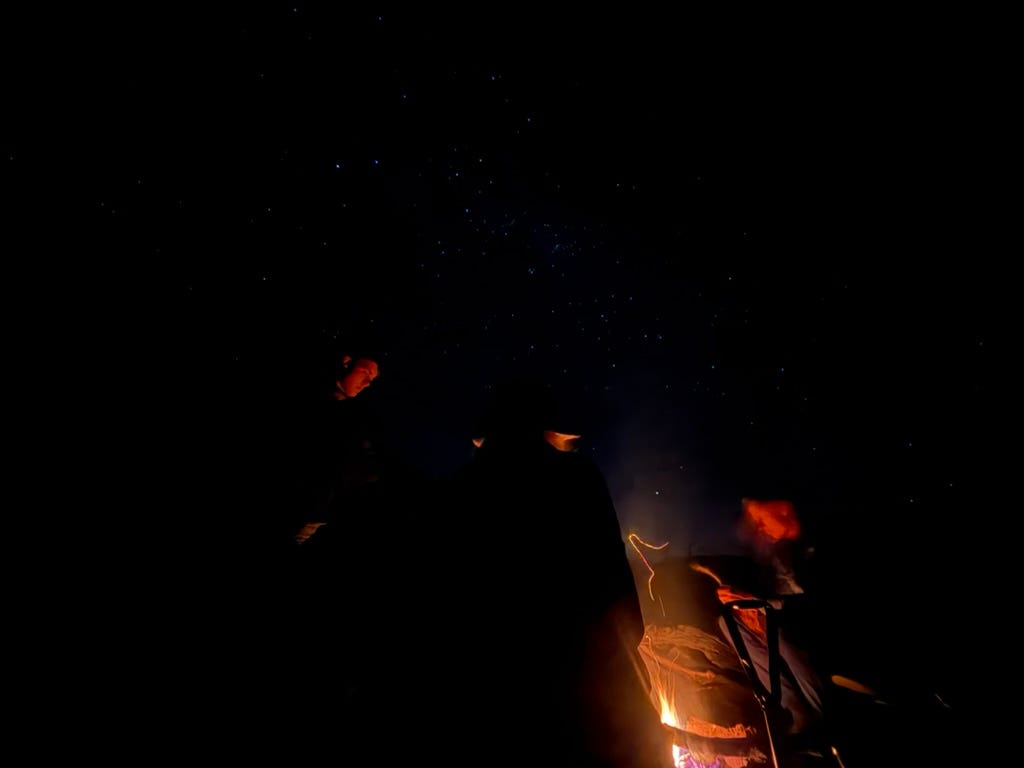
The night is cold. A jackal howls. I hear a clicking sound coming from the water. It must be a frog but I don’t know which one. It bothers me throughout my watch.
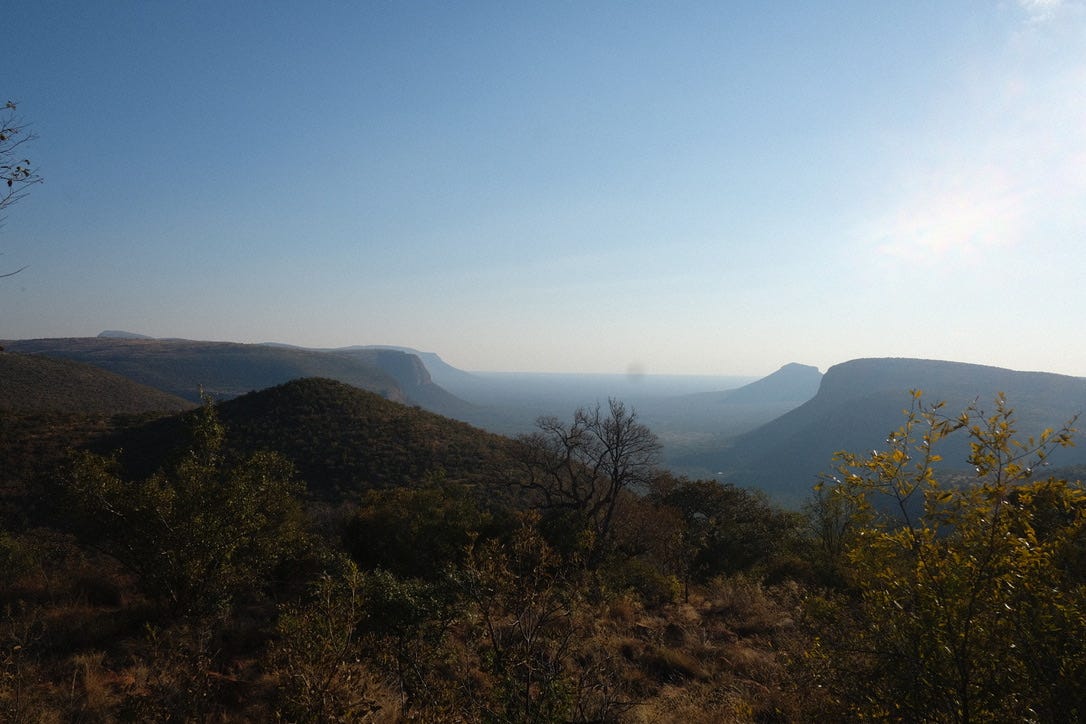
Daybreak. We drink our coffee by the smouldering fire, then pack up and start walking. We follow rhino trails through the thick vegetation. Marataba is black rhino country. Sickle bush thickets dominate the lower-lying areas. Sickle bush is a pioneer species that colonises disturbed soils. Cattle used to graze on these poor soils, and after decades of degradation the sickle bush, not needing much, moved in. It plays a vital role in the ecosystem by preventing erosion and returning nutrients to the soils, but it grows so densely that visibility, when walking through it, is nil. This isn’t ideal, as the large number of middens and branches cut off at 45 degrees tell us black rhino are everywhere. So we stop regularly and listen for a cracking branch, a snort, an oxpecker, anything that may give away a rhino before we startle it. A frightened black rhino is likely to charge rather than flee, and in this thickness there is nowhere to escape to.
After a long climb we reach the higher plateau. Here we find a large weeping wattle under whose cover we decide to spend the night. We drop our bags and climb a nearby kopje. It’s a steep climb and Ian, feeling his years, waits for us at the base. From the top the view is incredible. We each find a private spot and take in the wonder.
As always, the second night is better than the first. We have found our feet. The day of walking has forged a bond. My nerves have settled: everyone is enjoying themselves.
In the morning Ian hears oxpeckers calling close by. ‘Probably buffalo, or a rhino that has spent the night nearby,’ he says. We walk a hundred metres and there, exactly where he expected them, stand four old buffalo bulls, dagga boys, gazing at us. Old bulls pushed out of the herd by younger, more virile ones. Dagga means ‘mud’ in Zulu, as these old bulls like to spend their days wallowing in the mud, treating their old battle scars. Without the security of a large herd these dagga boys tend to be more aggressive, but these four are not in for a fight. They stare at us for a minute or so, then run, making a lot of noise as they bounce through the tall grass.
We walk down the valley, into Bushman’s Gorge. Before us lies all of Marakele National Park. Marakele means ‘place of sanctuary’ in Setswana. During the Mfecane, Mzilikazi, the Khumalo chief who broke from Shaka and founded the Ndebele kingdom, conquered vast swathes of land for his people, driving the Tswana west into arid Bechuanaland. A small group of Tswana found refuge in these mountains, which were sour and of little use to the Ndebele and their cattle. The mountains became an enclave, and to this day the main language of the region is Setswana.
We spend the day walking through an ancient landscape, following paths cut through the rock by the river over millions of years. Signs of rhino, black and white, are everywhere. They must be close, but we get no sight of them. We follow the gorge down to the Matlabas River, cross it, and climb the next mountain. We follow a trail, and the tracks tells us it is frequented by rhino, elephant, buffalo, lion, leopard, brown hyaena, caracal, civet and many other creatures.
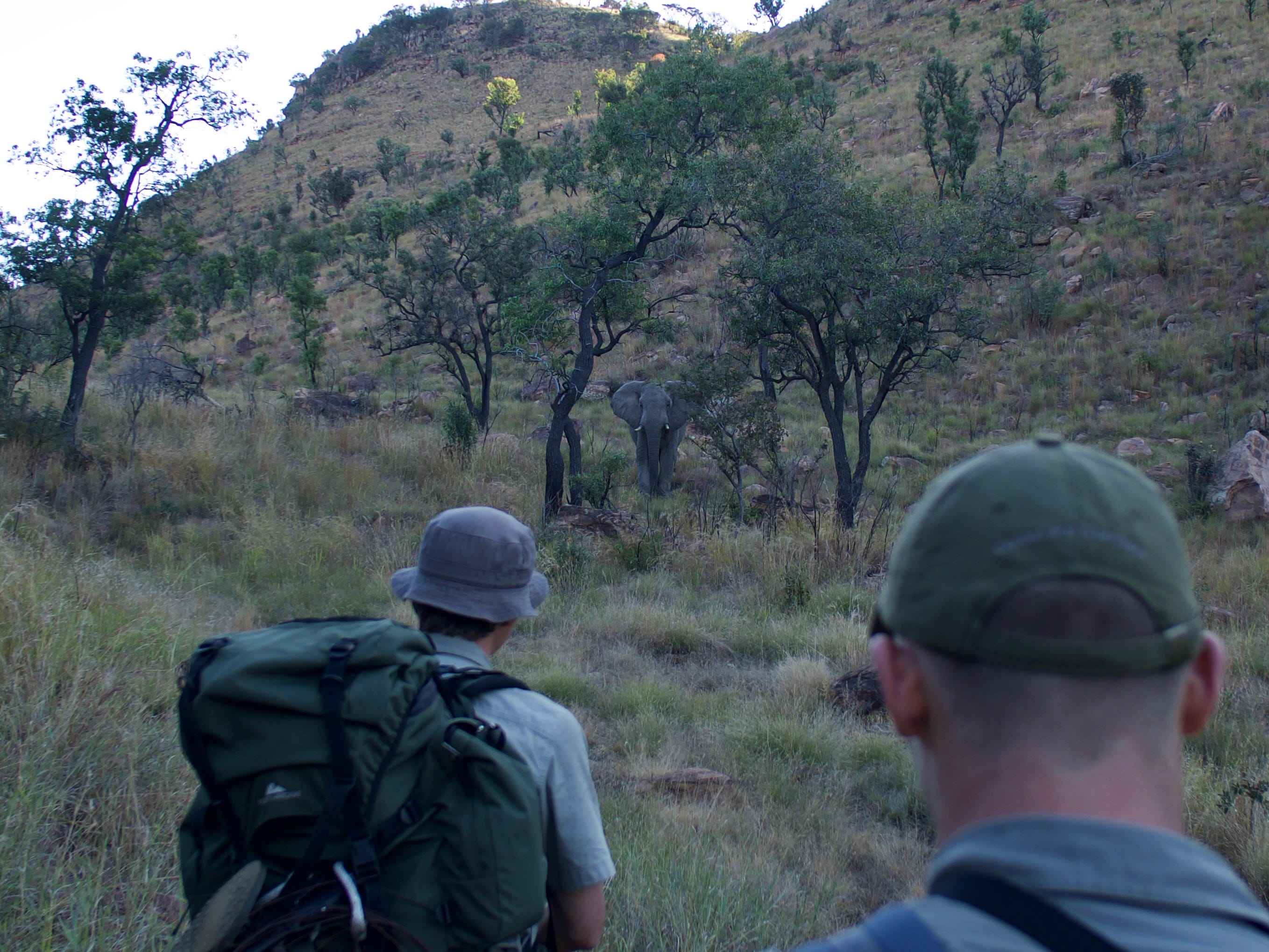
We climb higher. On top of the ridge, an elephant bull approaches us. There is only one clear mountain path and we are both on it. We decide to give him space and move some twenty metres off the path. The bull stops, hesitates. He is young and he seems very self-conscious. If he continues down the path he knows we’ll be watching him all the way down, and it seems he doesn’t want to undergo that embarrassment. So instead he comes up to us and gives us some grief, ears wide, chin up. He lets out a trumpet but leaves it at that. We climb up the ridge and give him a wide berth. A teenager in a foul mood.
Shortly after, we reach our sleeping spot. The view from here is magnificent. Once the fire is lit another elephant bull comes over the mountain pass. He is much more relaxed. He stays in our vicinity, and we hear branches crack throughout the night. That night is brutally cold.
When I wake my sleeping bag is covered in ice. We leave our backpacks on the top of the slope and descend into the next valley carrying with us only small bags with some water and snacks. Frozen dew covers the rhino middens along the path. We walk in total silence and enjoy the beauty of our surroundings privately.
To get back to our bags we have to climb a steep slope. The climb is tougher than I expected, the slope is steep and the sickle bush thick. Where there’s a will, there’s a way, I think. What’s The Long Way about if not this? That said, I am very relieved when we reach the top of the ridge. Ian is barely breathing. To my astonishment I see a pile of elephant dung up here. What possessed this bull to come all the way up here?
Once we’re reunited with our backpacks we take a short break, then descend into the valley, where we find a beautiful sleeping spot on a patch of smooth rock by the Matlabas. Again, a frigid night. I have a winter-grade sleeping bag, wear thermals, a mid-layer, a winter puffer jacket, a beanie and socks, and still I can barely sleep through the cold. Later we learn it was five degrees below zero on the plains that night. Up in the mountains it must have been colder still.
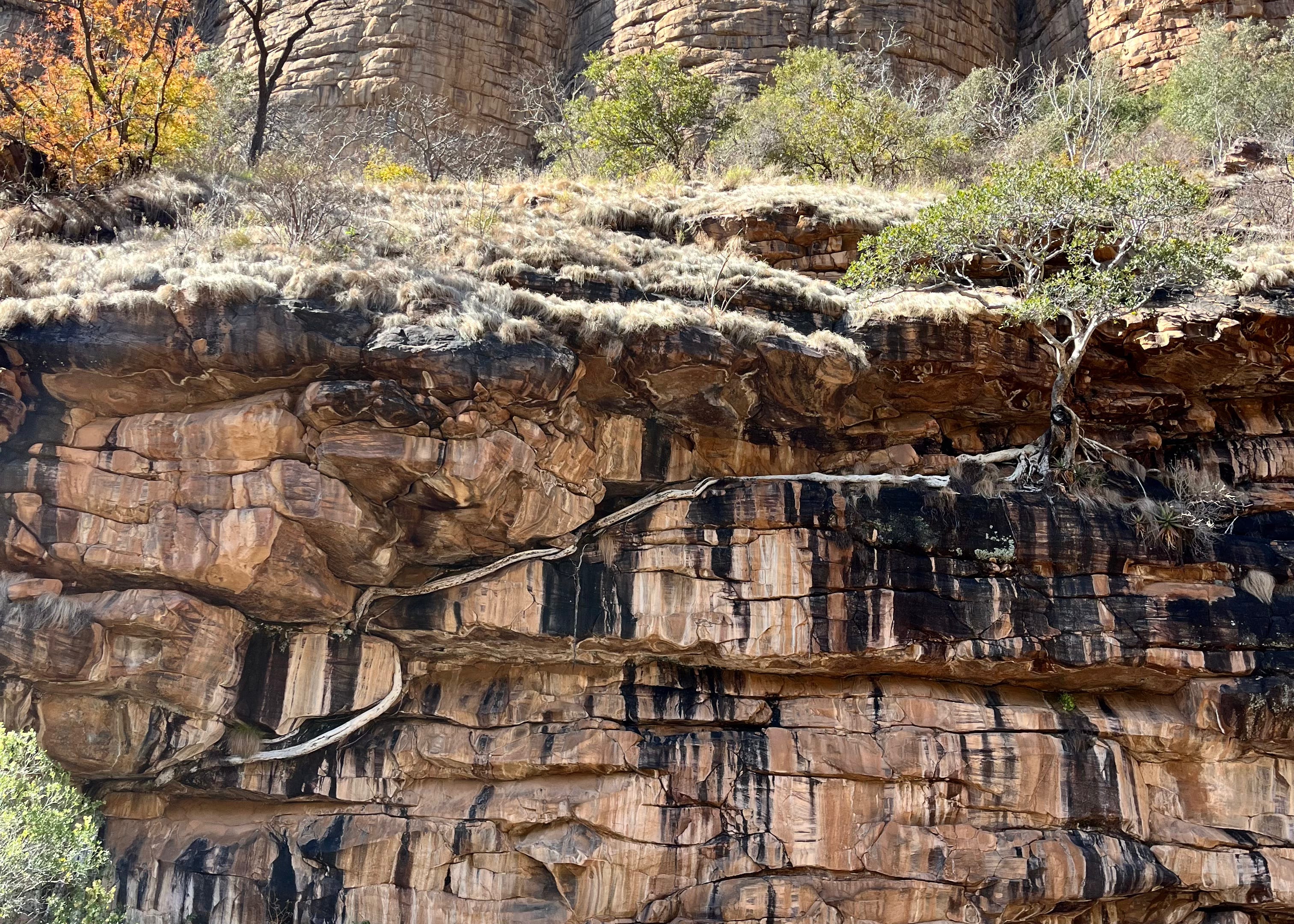
The last day we follow the meandering river down to the plain. We are flanked by steep, formidable walls that guide us through their gorge. Rock figs grow in the cracks. Their roots start as thin hairs that grow straight down, sometimes twenty metres, to find water as quickly as possible. Once they reach it, they grow thicker, more permanent, twisting and turning in the most wonderful ways to feed the tree. Over the years they grow so massive they crack open the rock, creating new opportunities for other trees.
We climb out of the gorge and follow the crest of the hill to our pickup point. Two Land Cruisers wait for us there. ‘Judging by the fact that all of you are here, I take it the trail was a success,’ says Kealan when he greets us. Suddenly the trail is over. We board the vehicle and drive to the camp where we will stay the last night. Along the way we see white rhino, elephants and lions. I guess there is something to be said for vehicle-based safaris after all.
Back in Cape Town
I stay in Green Point, a short walk from Manuel's boatyard, where Warrior is now on the hard. The contrast with the past weeks is sharp. Green Point is trendy in the way that's now the same everywhere: specialty coffee and Nordic bakeries on every corner, women in yoga outfits with matchas and cinnamon buns. After the bush it's all a bit overwhelming. The first proper coffee after two weeks of instant, the first dinner not rehydrated in a pouch: for a few days it’s wonderful. Then the joy wears off and the abundance starts to feel like overkill. It seems all people do here is consume, and I am now one of them. I order my second flat white with almond milk of the day, served in a paper cup with a plastic lid, and feel a wave of self-loathing.
I find myself longing for the wilderness again.
Thanks for reading The Long Way! Subscribe for free to receive new posts and support my work.
Originally published at the source. Subscribe for new stories.